
Introduction
E-commerce is booming in India, and Amazon stands tall as one of the biggest platforms connecting sellers to millions of customers nationwide. Whether you’re a manufacturer, wholesaler, or small retailer, Amazon allows you to scale your business without spending huge amounts on infrastructure or marketing. But how do you get started? This guide breaks it all down into simple, actionable steps.
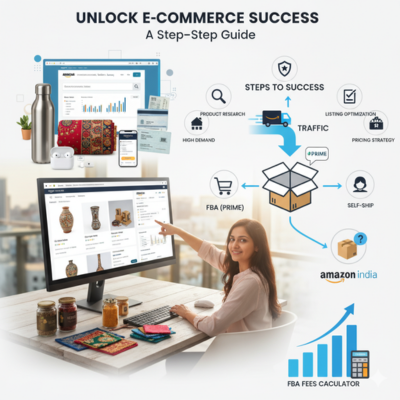
Understanding Amazon India Marketplace
Amazon India operates as an online marketplace where sellers list their products and customers purchase them. Amazon provides logistics, customer service, and marketing support, enabling sellers to focus more on their products. For new entrepreneurs, this is a golden chance to start selling with low investment and high reach.
Step 1: Decide What to Sell
Your journey begins with the product. Picking the right product can make or break your Amazon business.
- Research trending categories such as electronics accessories, fashion, beauty, kitchen tools, and home decor.
- Examine competitors’ pricing and reviews to identify areas for improvement.
- Use Amazon tools like “Best Sellers” and “Movers & Shakers” to spot opportunities.
Deep Dive: Product Research and Validation for Maximum ROI
Before investing in inventory, validate your product idea to minimize risk. A winning product often meets three criteria: High Demand, Low Competition, and Good Profit Margins.
- Analyze Search Volume: Utilize external tools or the Amazon Search Bar Autocomplete feature to determine how frequently customers search for your product keywords. High search volume indicates strong demand.
- Evaluate Competition Quality: Search your main keyword and scrutinize the top 10 listings. Are their images poor? Are their descriptions incomplete? Low-quality competition means you can easily differentiate and capture market share by offering a superior listing.
- Calculate the 30% Rule: Aim for a product where your final selling price is at least 30% higher than your total cost (including product manufacturing, shipping to you, and Amazon’s FBA/Easy Ship fees). This buffer is crucial for covering ad costs, returns, and unexpected expenses while ensuring healthy profit.
- Look for ‘Evergreen’ Demand: While seasonal products offer quick spikes, evergreen products (like basic kitchenware, organizers, or standard tech accessories) provide consistent, year-round sales, which is better for building a stable business.
Step 2: Create Your Amazon Seller Account
To sell on Amazon, you need an Amazon Seller Account. The process is simple, but you must keep certain documents handy. Requirements:
- PAN card of the business or individual
- GST registration certificate
- Bank account details
Business address proof once registered on sellercentral.amazon.in, you can start listing products.
Step 3: Choose the Right Selling Plan
Amazon offers two main plans:
- Individual Plan – Best for beginners selling less than 40 products per month.
- Professional Plan – For serious sellers who want to scale. Each comes with its own fees and commissions (referral fees, closing fees, and shipping charges).
Step 4: Set Up Your Product Listings
A good product listing is like your digital storefront. It’s what convinces customers to click “Buy Now.”
- Titles – Include keywords naturally (e.g., “Stainless Steel Water Bottle 1L – Leakproof & BPA Free”).
- Descriptions – Write clear, benefit-driven descriptions.
- Bullet Points – Highlight features like material, durability, or warranty.
- SEO – Use relevant keywords to appear in Amazon searches.
Step 5: Manage Inventory and Pricing
Your products should never go out of stock. Amazon penalizes inactive listings.
- Use Amazon Seller Central tools to track stock.
- Adopt competitive pricing by analyzing your competitors.
- Factor in Amazon fees before setting final prices.
Step 6: Choose Your Fulfillment Method
Amazon provides three ways to fulfill orders:
- Fulfillment by Amazon (FBA): You send products to Amazon’s warehouse, and they handle packaging, delivery, and returns.
- Easy Ship: Amazon picks the product from you, packs, and delivers it.
- Self-Ship: You manage shipping yourself. Most sellers prefer FBA because it boosts visibility with the “Prime” badge.
Understanding the True Cost of Fulfillment by Amazon (FBA)
While FBA is crucial for getting the Prime badge and scaling quickly, sellers must accurately calculate its fees to avoid selling at a loss. FBA is not free; it’s a paid, premium service.
The three main FBA costs you must factor into your pricing are:
- FBA Pick & Pack Fee: A fixed charge for Amazon staff locating your product in the warehouse, picking it up, packing it securely, and labeling the package. This depends on the size and weight of the product (e.g., standard size, oversized).
- FBA Shipping Fee: This is the cost of shipping the packaged order to the customer. It is a weight-based charge and varies by the distance/zone (Local, Regional, National). Note: This replaces your own shipping cost but is generally higher as it includes the premium Prime delivery service.
- Monthly Storage Fee: A recurring fee for keeping your inventory in Amazon’s fulfillment centers. This is calculated based on the average daily volume (in cubic feet) your inventory occupies. Be wary of long-term storage fees (charged after 180 days) on slow-moving inventory, which can eat into your profits quickly.
Pro Tip: Always use the Amazon Revenue Calculator tool to get the precise breakup of the total fees before finalizing your retail price.
Step 7: Optimize Product Images and Content
First impressions matter. High-quality images increase conversion rates.
- Use professional, high-resolution photos on white backgrounds.
- Show lifestyle images (product in use).
- Brand-registered sellers can use A+ Content to enhance listings with videos and comparison charts.
Step 8: Market Your Products
Simply listing your product won’t bring sales—you need to promote.
- Amazon Sponsored Ads: Pay-per-click ads to appear at the top of search results.
- Deals and Coupons: Attract price-sensitive buyers.
- External Promotions: Run Instagram, Facebook, or Google Ads to drive traffic.
Step 9: Provide Excellent Customer Service
Happy customers mean repeat business.
- Respond quickly to buyer queries.
- Maintain a hassle-free return policy.
- Focus on getting positive reviews, as they build trust.
Step 10: Track Performance and Improve
Amazon provides a powerful Seller Central Dashboard with analytics.
- Track your sales trends.
- Identify your best-selling products.
- Improve weak listings with better titles, keywords, or pricing.
The Power of Brand Registry: Elevating from Seller to Brand Owner
Once your business gains traction, your biggest asset is your Brand. Registering your trademark (even a pending one) with the Amazon Brand Registry is an essential step toward scaling and securing your business.
Key Advantages of Brand Registry:
- A+ Content Access: Unlock the ability to create visually rich product pages with detailed module layouts, enhanced images, and comparison tables, drastically improving conversion rates over basic descriptions.
- Storefront Creation: Build a dedicated, multi-page, branded Amazon Storefront to showcase your entire product catalog in one beautiful digital location, offering customers a curated brand experience.
- Increased Protection: Gain powerful tools to combat counterfeiters, unauthorized sellers (hijackers), and protect your intellectual property, ensuring that your customers only receive genuine products.
- Advanced Ad Formats: Access premium advertising solutions like Sponsored Brands (banners at the top of search results) and Sponsored Display ads, which are unavailable to non-branded sellers.
The shift from simply ‘selling products’ to ‘building a brand’ is the pathway to long-term success and higher valuation on Amazon.
Legal and Tax Considerations
Every seller must comply with Indian tax laws.
- GST is mandatory for most categories.
- Ensure invoices are GST-compliant.
- Keep track of returns and file GST accordingly.
Common Mistakes New Sellers Make
- Poor product images and weak SEO.
- Pricing too high or too low without analyzing fees.
- Ignoring customer feedback.
- Running out of stock during festive seasons.
Tips to Scale Your Amazon Business in India
Once you start getting sales, think big!
- Expand your product line.
- Use Amazon Global Selling to reach international buyers.
- Build your brand with A+ content and social media presence.
Conclusion
Selling on Amazon in India is one of the easiest ways to step into the e-commerce world. From product selection to account setup, listing optimization, and marketing—every step plays a vital role in success. The key is consistency, patience, and continuous learning. Start small, learn the ropes, and scale gradually.
How much money do I need to start selling on Amazon in India?
How does FBA work in India? .
Do I need to renew my license?
What is the best category to start selling?.
How long does it take to get the first sale? .
This revised guide includes three detailed, SEO-focused sections designed to provide actionable advice on product validation, true cost analysis, and brand building, making it even more valuable to the target audience. Do you have any other sections you’d like to expand upon